
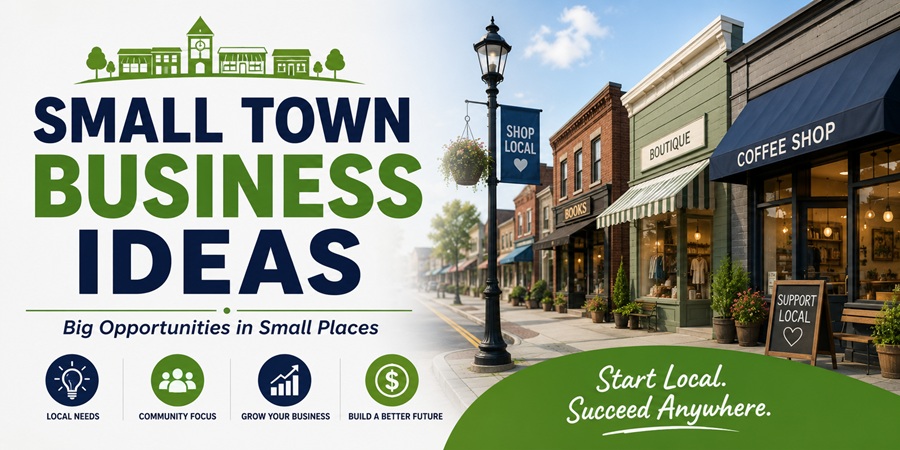

Starting a business in a small town isn’t a lesser version of starting one in a city. It’s a different set of conditions entirely — and for the right business model, those conditions are an advantage, not a limitation.
Small towns have real structural advantages: lower commercial rent, less direct competition, stronger word-of-mouth dynamics, and a customer base that tends to be loyal once you’ve earned their trust. The businesses that thrive in small markets are the ones built around what those markets actually need — not transplanted versions of urban concepts that depend on population density and foot traffic that simply doesn’t exist outside major metros.
Here’s where the genuine opportunities tend to be.
Fill the Gaps That Chains Don’t
The most reliable small town business opportunities come from identifying what residents currently drive 30 or 45 minutes to access. Every small town has a version of this list — a decent sit-down restaurant, a hardware store, a reliable auto repair shop, a pharmacy with real service, a physical therapy clinic. When a national chain closes or never opens in the first place, it leaves a gap that a locally owned business can fill with a significant built-in advantage: you’re already there.
This “gap analysis” approach sounds simple, but it’s surprisingly underused. Before committing to any concept, spend time mapping what exists in your town and what consistently sends residents elsewhere. The businesses that survive decades in small markets are almost always the ones that solved a problem nobody else was solving locally.
Food and Hospitality
A well-run independent restaurant, café, or bakery in a small town without strong competition can become the social anchor of a community — the kind of place people visit not just for the food but for the familiarity. That cultural role is hard to replicate and creates loyalty that a chain never earns.
The economics require careful attention. A food business in a small market has a natural revenue ceiling tied to population size, so cost control and menu efficiency matter more than in higher-volume urban locations. Catering — for local events, weddings, corporate functions within a reasonable radius — can extend revenue significantly beyond what walk-in traffic alone supports.
Breweries and wineries have also proven unusually successful in small and rural markets over the past decade. They draw visitors from surrounding areas, create destination traffic that other businesses benefit from, and tend to become community gathering points in the same way that traditional taverns once did.
Essential Services With Limited Local Competition
Several service categories are chronically underserved in small towns and carry strong demand regardless of economic conditions.
Healthcare and wellness. Rural areas face persistent shortages of primary care, dental, mental health, and physical therapy services. A licensed practitioner willing to establish in a small market often faces minimal competition and immediate patient demand. Telehealth has expanded what’s viable in this space, but in-person care still carries distinct advantages in community trust and certain treatment categories.
Skilled trades. Electricians, plumbers, HVAC technicians, and general contractors are in short supply in most small and rural markets. A reliable, fairly priced tradesperson in a small town builds a reputation quickly and rarely lacks for work. The barrier to entry is licensure and skill — not capital. Many skilled tradespeople in small markets build substantial businesses simply by being dependable in markets where dependability is scarce.
Childcare. Affordable, quality childcare is one of the most acute needs in rural communities. Demand consistently outstrips supply. A licensed home daycare or small childcare center addresses a genuine community need, benefits from minimal local competition, and can qualify for state subsidy programs that support both operators and families.
Automotive services. In towns where the nearest dealership is a significant drive away, a reliable mechanic who does honest work builds a loyal customer base that sustains a business for decades. Specialty services — diesel repair, farm equipment maintenance, tire and alignment work — can add meaningful revenue in agricultural communities.
Retail With a Reason to Exist
Generic retail is difficult in small towns, partly because e-commerce has shifted purchase behavior and partly because a small market can’t support a store that doesn’t offer something specific and compelling. The retail businesses that succeed in small markets tend to be highly curated or deeply specialized.
A farm supply and feed store serves agricultural communities in ways that no online retailer can replicate. A locally focused gift and goods shop that stocks products from regional makers fills a niche that feels distinctly different from shopping online. A hardware and home store that carries knowledgeable, attentive staff provides value that the nearest big-box can’t match on service alone.
The question to ask about any retail concept in a small market isn’t “could this work somewhere?” — it’s “why would someone here choose this over ordering it online or driving to the city?” If the answer is clear and compelling, the concept has a foundation.
Tourism and Experience-Based Businesses
Small towns within driving distance of natural attractions, historic sites, or scenic areas have an additional category of opportunity: businesses that serve visitors rather than just locals. Bed and breakfasts, vacation rental properties, guided outdoor experiences, antique stores, and event venues all fall into this category.
The key variable is whether your town actually draws visitors or has the potential to. Not every small town does. But those that sit near lakes, mountains, national forests, wine regions, or historic districts often have underserved visitor demand that locals are well-positioned to capture. A weekend visitor economy can sustain businesses that a local-only customer base couldn’t.
Online Businesses With Local Roots
One underappreciated option for small-town entrepreneurs is running a primarily online business that happens to be based in a small town. E-commerce, freelance services, content creation, and remote consulting all benefit from small-town overhead costs — lower rent, lower cost of living — while drawing revenue from a national or global market.
This model inverts the usual small-town constraint. Instead of being limited by local population, you’re competing in a larger market while keeping your costs lower than urban competitors. It requires digital skills and a marketable product or service, but for the right entrepreneur, it’s one of the strongest structural advantages a small-town location offers.
The One Question Worth Asking First
Before landing on any specific concept, spend time with this question: what do people in this town talk about needing, and why hasn’t anyone filled that need yet?
Sometimes the answer reveals a genuine opportunity. Sometimes it reveals why previous attempts failed — regulatory barriers, insufficient population, seasonal demand that doesn’t sustain year-round operations. Either way, the answer is more valuable than any list of ideas.
The USDA Rural Development Business Programs offers grants, loans, and technical assistance specifically designed for businesses launching in rural and small-town markets — a resource most small-town entrepreneurs overlook entirely when exploring financing options.