

A business card is often the first physical thing someone receives from you. Before they remember your name, your title, or what you discussed, they’ve already registered whether the card felt right in their hand. Size is a bigger part of that impression than most people realize, and getting it wrong creates a problem that no amount of good design can fix.
The good news is that standard sizes are well-established, widely supported by print vendors, and easy to work within once you understand the basics.
The Standard Business Card Size in the US
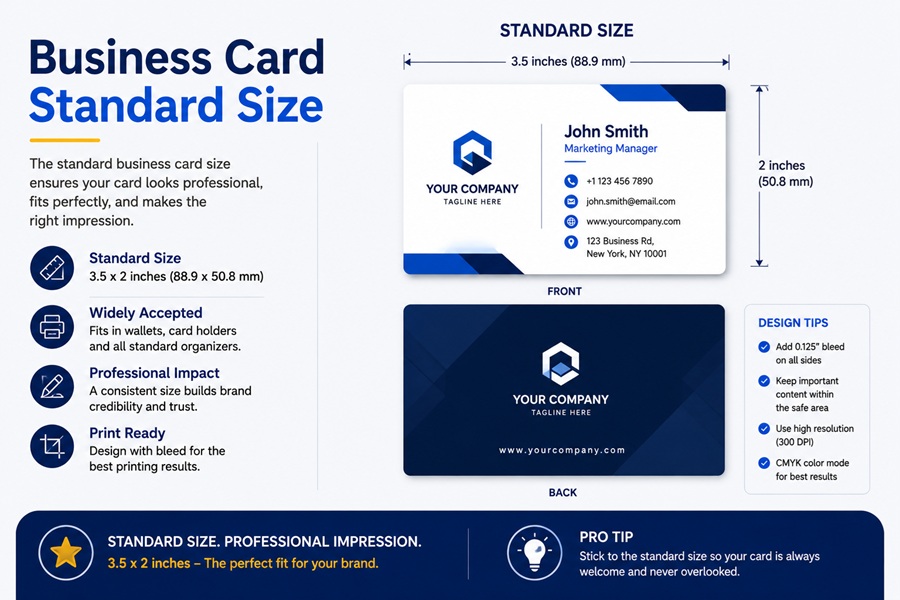
The standard business card size in the United States is 3.5 inches wide by 2 inches tall (88.9mm x 50.8mm). This is the format that fits standard cardholders, wallet slots, and business card organizers. Every major print vendor supports it. Every professional design tool has it as a preset. If you’re not sure which size to use, this is the one.
The 3.5 x 2 inch format became standard because it fits a standard wallet slot perfectly, the same dimensions as a credit card in terms of width. That compatibility made it the natural default for the North American market, and it’s held that position for decades.
Standard Sizes Around the World
Business card dimensions vary by country, and if you’re printing cards for international use, the differences matter.
United Kingdom and Europe: 85mm x 55mm (3.346 x 2.165 inches). Slightly larger than the US standard, this is the ISO 216 compliant format used across most of Europe.
Japan: 91mm x 55mm (3.582 x 2.165 inches). Japan’s meishi culture treats the business card exchange as a formal ritual, and the slightly wider format is the accepted standard. Using a non-standard size in Japan can signal unfamiliarity with business etiquette.
Australia: 90mm x 55mm (3.543 x 2.165 inches). Similar to the European format but with a slight width difference.
China: 90mm x 54mm (3.543 x 2.126 inches). Close to the European standard, with a marginally smaller height.
If you travel frequently for business or distribute cards across multiple countries, it’s worth printing to the local standard for each market rather than using a one-size-fits-all approach. A card that doesn’t fit neatly into a standard cardholder gets discarded faster than one that does.
Bleed, Safe Zone, and Print-Ready Dimensions
When setting up a business card file for print, the 3.5 x 2 inch finished size is not the same as the file dimensions you submit. Three zones define how a print-ready business card file should be set up.
Bleed area: 3.75 x 2.25 inches. The bleed extends 0.125 inches (1/8 inch) beyond the finished size on all sides. Any background color or design element that reaches the edge of the card needs to extend into the bleed to avoid white edges after trimming.
Safe zone: 3.25 x 1.75 inches. Text, logos, and any critical design elements should be kept within this inner boundary, 0.125 inches inside the finished edge on all sides. Cutting is never perfectly precise, and content placed too close to the edge risks being trimmed.
Finished size: 3.5 x 2 inches. The actual card after trimming.
Most professional design applications including Adobe Illustrator, InDesign, and Canva allow you to set up these boundaries when creating a new document. If you’re using a print vendor’s template, these guides are typically pre-built into the file.
Resolution should be set to 300 DPI (dots per inch) minimum for print. Files designed at 72 DPI for screen will print poorly regardless of how sharp they look on a monitor.
Orientation: Horizontal vs. Vertical
The standard 3.5 x 2 inch dimensions assume a horizontal (landscape) orientation, which is the conventional format for most business cards in the US and Europe. Vertical (portrait) cards use the same dimensions rotated: 2 inches wide by 3.5 inches tall.
Vertical cards have become more common as a design choice for brands that want to stand out, and they work well with certain layouts. The practical consideration is that vertical cards sit awkwardly in standard horizontal card holders and wallets, which affects how long they stay in circulation before being discarded.
For most professional contexts, horizontal orientation is the safer choice. For creative industries where differentiation is valued and recipients are less likely to be sorting cards into corporate cardholders, vertical orientation can be an effective design decision. The AIGA, the professional association for design, offers guidance on print design standards and professional presentation materials that covers how format choices affect brand perception across different industry contexts.
Non-Standard Sizes Worth Knowing
Several alternative sizes have established enough use that print vendors support them as standard options.
Square cards (2.5 x 2.5 inches): Popular in creative industries and among brands with strong visual identities. Square cards stand out in a stack and photograph well for social media. The trade-off is that they don’t fit standard cardholders.
Mini cards (3.5 x 1 inch): Half the height of a standard card, mini cards have found a niche as a distinctive format for simple, clean information. MOO popularized this format and continues to offer it as a core product.
Folded cards (3.5 x 4 inches, folds to 3.5 x 2 inches): Useful for people who need more content space without going to a full-size brochure. Common among photographers, consultants, and service professionals who want to include a portfolio image, service list, or biography on the inside panel.
Rounded corner cards: Not a different size but a finishing option that softens the standard dimensions. Rounded corners have become increasingly popular as a premium finish that makes a card feel more refined in the hand.
Paper Stock and Thickness
Size is one dimension of how a card feels. Paper stock is the other, and it has an outsized effect on first impressions.
Standard business card paper is typically 14pt or 16pt card stock. 14pt is the industry baseline: firm, professional, and what you’ll receive from most standard print runs. 16pt is noticeably thicker and conveys a sense of quality that 14pt doesn’t quite reach. Premium options extend to 18pt, 32pt, and specialty materials including soft-touch laminate, silk coating, uncoated textured stock, and metal or plastic substrates.
Thicker paper with quality finishing costs more per card but produces a substantially better first impression. For most professionals, the difference between a 14pt standard card and a 16pt soft-touch card is immediately perceptible and worth the incremental cost.
Setting Up Your File Correctly
Whether you’re designing the card yourself or handing specifications to a designer, getting the setup right before any design work happens avoids expensive reprints and missed deadlines.
The correct approach for a US standard horizontal business card:
Set the document size to 3.75 x 2.25 inches to include bleed. Set up guides at 0.125 inches inside each edge to mark the trim line and safe zone. Set color mode to CMYK rather than RGB for accurate print color reproduction. Set resolution to 300 DPI. Export as a print-ready PDF with bleed marks included.
For anyone producing business cards professionally or at scale, the Printing Industries of America maintains industry standards and technical specifications for commercial print production including business cards, and is the most authoritative reference for print production specifications in North America.
The Practical Summary
For the vast majority of professionals in the United States, the right business card size is 3.5 x 2 inches, horizontal orientation, on 16pt card stock with a quality finish. Set up the file at 3.75 x 2.25 inches with bleed, keep critical content within the 3.25 x 1.75 inch safe zone, and export at 300 DPI in CMYK color mode.
Everything beyond that is a design decision. But getting the fundamentals right first means the design has a proper foundation to work from.