
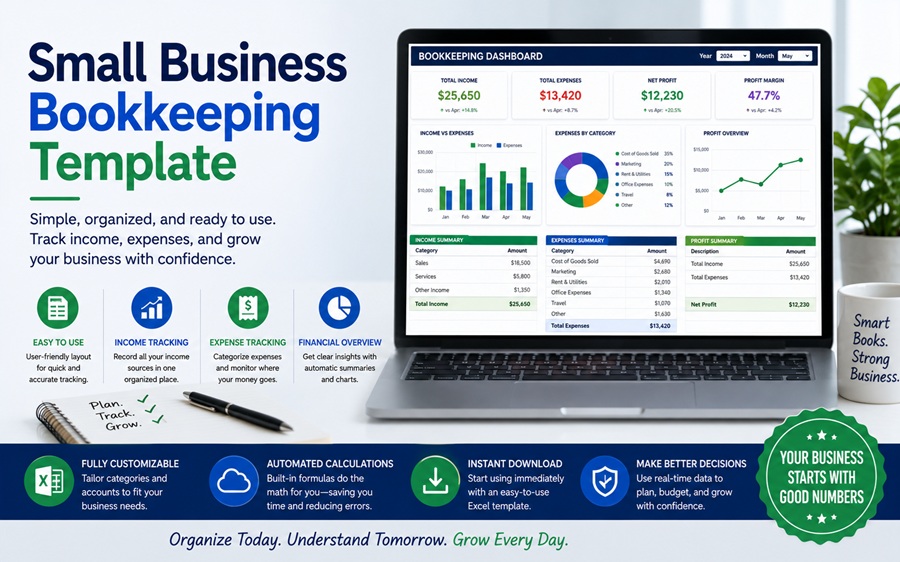

Most small business owners start bookkeeping the same way — a spreadsheet that made sense at the time, a shoebox of receipts, or a bank account they check occasionally and hope for the best. It works until it doesn’t, and it usually stops working at the worst possible moment: tax season, a funding conversation, or the first time cash flow becomes genuinely tight.
A proper bookkeeping template doesn’t require accounting software or a finance background. It requires a clear structure applied consistently, and an understanding of what you actually need to track to make good business decisions.
What a Small Business Bookkeeping Template Needs to Cover
Before building or downloading any template, it helps to understand what the core components are and why each one matters.
Income tracking. Every payment received needs to be recorded with the date, the client or source, the amount, and the category. This isn’t just for tax purposes. It tells you which revenue streams are growing, which are inconsistent, and whether your business is actually increasing its income over time or just feeling busier.
Expense tracking. Every business expenditure needs the same treatment. Date, vendor, amount, and category. The category matters because it determines deductibility at tax time and tells you where your money is going at a glance. Lumping all expenses into a single column is how businesses discover too late that they’ve been overspending in areas they never examined.
Accounts receivable. If you invoice clients rather than collecting payment immediately, you need a running record of what’s been invoiced, what’s been paid, and what’s outstanding. Unpaid invoices are one of the most common causes of cash flow problems in small businesses that are otherwise profitable on paper.
Accounts payable. The equivalent on the expense side. What bills are due, when they’re due, and what’s already been paid. This prevents missed payments and gives you a forward-looking view of cash requirements.
Cash flow summary. A monthly view of money in versus money out, ending with your net position. This is the number that tells you whether the business is generating cash or consuming it, regardless of what the profit figure looks like.
A Simple Template Structure That Works
For a small business that isn’t ready for dedicated accounting software, a well-organized spreadsheet covering these five areas handles the vast majority of what needs to be tracked. Here’s how to structure each tab.
Tab 1: Income Log
Columns: Date, Invoice Number, Client Name, Description, Amount, Payment Method, Date Received, Status (paid or outstanding).
Keep this chronological. Add a summary row at the bottom of each month that totals income received and income outstanding. Over time, this tab becomes your revenue history.
Tab 2: Expense Log
Columns: Date, Vendor, Description, Category, Amount, Payment Method, Receipt Attached (yes or no).
Expense categories worth setting up from the start: office supplies, software and subscriptions, marketing and advertising, professional services, travel, meals and entertainment, utilities, rent, insurance, payroll, and a miscellaneous category for everything that doesn’t fit neatly. The IRS and HMRC both have defined categories that align with common expense types, so building your categories around their structure makes tax preparation significantly easier.
Tab 3: Accounts Receivable
Columns: Invoice Number, Client, Invoice Date, Due Date, Amount, Date Paid, Amount Paid, Balance Outstanding.
Sort this by due date so overdue invoices surface immediately. A simple conditional formatting rule that highlights rows where the due date has passed and the balance is still outstanding makes it impossible to miss aged receivables.
Tab 4: Accounts Payable
Columns: Vendor, Invoice Number, Invoice Date, Due Date, Amount, Date Paid, Status.
The same logic applies. Sort by due date and highlight anything overdue. Knowing what’s due in the next 30 days at a glance is one of the most practical financial management tools a small business can have.
Tab 5: Monthly Cash Flow Summary
This tab pulls from the others. For each month: total income received, total expenses paid, net cash flow for the month, and running cash balance. Add a simple chart that visualizes the trend over time. Patterns that aren’t visible in the raw numbers become immediately obvious in a chart.
Categories the IRS Recognizes for Small Business Deductions
Setting up your expense categories correctly from the beginning saves significant time at tax filing and ensures you’re capturing every legitimate deduction. The IRS Schedule C, used by sole proprietors and single-member LLCs, organizes business expenses into the following categories that are worth mirroring in your template:
Advertising, car and truck expenses, commissions and fees, contract labor, depreciation, employee benefit programs, insurance, legal and professional services, office expenses, rent or lease payments, repairs and maintenance, supplies, taxes and licenses, travel, meals, utilities, wages, and other expenses.
Not every category will apply to every business. Build the ones relevant to your business into your template from the start, and add others as needed rather than building out the full list upfront.
What to Do With the Template Every Week
A bookkeeping template is only useful if it’s maintained consistently. The businesses that get the most value from structured bookkeeping are the ones that treat it as a weekly practice rather than a monthly scramble.
A fifteen-minute weekly routine covers the essentials. Log all income received during the week. Log all expenses paid. Check accounts receivable for any invoices that have become overdue and follow up immediately. Confirm that upcoming payables are covered by available cash. That’s it. Fifteen minutes per week prevents the hours of reconstruction that happens when records are left for weeks or months.
End-of-month takes slightly longer. Reconcile your template against your bank statement to catch anything missed. Update the cash flow summary. Review the month’s numbers for anything unexpected. This reconciliation step is where errors surface before they compound.
When to Move Beyond a Spreadsheet
A spreadsheet template works well for businesses in their early stages, those with straightforward finances, and owners who want to understand their numbers before delegating them. It stops being the right tool when transaction volume makes manual entry genuinely burdensome, when the business has employees and payroll to manage, or when the complexity of the financial picture requires more sophisticated reporting than a spreadsheet produces efficiently.
The IRS Small Business and Self-Employed Tax Center provides guidance on recordkeeping requirements, deductible expense categories, and the specific documentation needed to support deductions at audit — and is the most authoritative free resource for understanding exactly what a small business bookkeeping system needs to capture from a tax compliance perspective.
The One Habit That Makes Every Template Work
No template, regardless of how well it’s designed, compensates for inconsistent use. The businesses that maintain clean, useful books share one habit: they record transactions as they happen rather than reconstructing them later. A receipt photographed and logged the day it’s received takes thirty seconds. The same receipt found in a bag three months later takes ten minutes to identify, categorize, and enter accurately. Multiply that difference across every transaction in a year and the case for timely recording is overwhelming.
The template is the structure. The habit is what makes it valuable.