
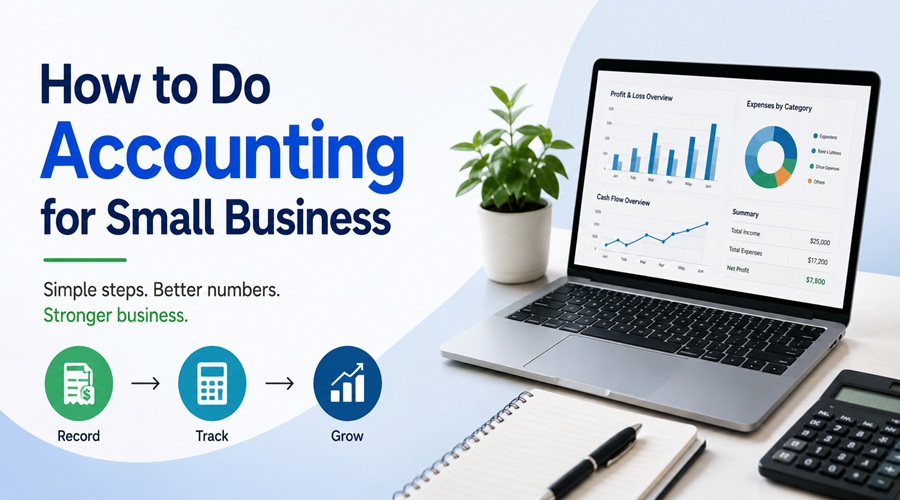

Accounting has a reputation for complexity that keeps many small business owners at arm’s length from their own numbers. The reality is that basic small business accounting follows a straightforward logic, and understanding that logic well enough to manage it yourself — or at least understand what your accountant is doing — is one of the most valuable things a business owner can learn.
This isn’t about becoming a CPA. It’s about understanding where money comes from, where it goes, and what the numbers are actually telling you about the health of your business.
The Foundation: Cash vs. Accrual Accounting
Before tracking a single transaction, you need to choose an accounting method. The two options are cash basis and accrual basis, and the difference between them affects when income and expenses are recorded.
Cash basis accounting records income when payment is received and expenses when they’re paid. It’s simpler, more intuitive, and the right choice for most small businesses starting out. If a client pays you in March for work done in February, the income lands in March under cash basis.
Accrual basis accounting records income when it’s earned and expenses when they’re incurred, regardless of when cash changes hands. A business that invoices in February records the income in February even if the client pays in March. Accrual accounting gives a more accurate picture of financial performance over time but requires more careful management of accounts receivable and payable.
The IRS requires businesses with inventory or annual gross receipts above $25 million to use accrual accounting. Below that threshold, most small businesses can choose. Cash basis is the simpler starting point for most.
The Core Accounting Cycle
Accounting for a small business follows a repeating cycle of activities. Understanding the cycle makes the whole system feel less like a collection of disconnected tasks and more like a coherent process.
Record transactions. Every financial event — a sale, a purchase, a bill payment, a payroll run — gets recorded as it happens. In double-entry accounting, every transaction affects at least two accounts. A sale increases both your revenue account and your bank account. A purchase decreases your bank account and increases your expense account. This two-sided recording is what keeps the books balanced.
Categorize and organize. Transactions get sorted into categories that eventually roll up into financial statements. Income categories, expense categories, asset accounts, liability accounts. The chart of accounts — the master list of all categories your business uses — is the organizational backbone of your accounting system.
Reconcile regularly. At least monthly, your recorded transactions should be compared against your actual bank and credit card statements to catch errors, missing entries, and unauthorized charges. Reconciliation is the quality control step that keeps your books accurate.
Produce financial statements. At the end of each reporting period — monthly, quarterly, annually — the transaction records produce three core financial statements. The profit and loss statement shows revenue, expenses, and net income over a period. The balance sheet shows what the business owns (assets), what it owes (liabilities), and the difference (equity) at a specific point in time. The cash flow statement shows how cash moved through the business.
File taxes. Annual tax filing uses the year’s accounting records to calculate what the business owes. Clean, well-maintained books make this process straightforward. Reconstructed or incomplete records make it expensive and stressful.
Setting Up Your Chart of Accounts
The chart of accounts is the list of categories that every transaction gets assigned to. Getting this right at the start saves significant reorganization work later.
A basic small business chart of accounts covers five types of accounts.
Assets include checking accounts, savings accounts, accounts receivable (money owed to you), inventory, equipment, and prepaid expenses. These are things the business owns or is owed.
Liabilities include accounts payable (money you owe), credit card balances, loans, and accrued expenses. These are obligations the business has to others.
Equity is the owner’s stake in the business, including contributed capital and retained earnings accumulated over time.
Revenue covers all income streams — product sales, service fees, consulting income, interest income, and any other sources of revenue the business generates.
Expenses cover all costs of operating — rent, payroll, software, marketing, insurance, supplies, professional services, utilities, and the rest. Setting up expense categories that align with IRS Schedule C categories from the start makes tax preparation significantly easier.
The Three Financial Statements and What They Tell You
Most small business owners focus almost entirely on their bank balance as a measure of financial health. The three core financial statements tell a much more complete story.
The Profit and Loss Statement (P&L). Also called the income statement, this shows total revenue minus total expenses over a period, producing a net profit or net loss figure. The P&L tells you whether the business is profitable, which revenue streams are largest, and which expense categories are consuming the most resources. A business can look busy and feel successful while the P&L quietly shows that expenses are outpacing revenue.
The Balance Sheet. A snapshot of the business’s financial position at a specific moment. The fundamental equation it expresses is assets equal liabilities plus equity. A healthy balance sheet shows assets growing faster than liabilities and positive equity that increases over time. A business accumulating debt faster than assets is visible in the balance sheet before it becomes a crisis in the bank account.
The Cash Flow Statement. Profit and cash are not the same thing, and the cash flow statement is where that distinction becomes visible. A profitable business can run out of cash if it extends long payment terms to customers while paying its own bills quickly. The cash flow statement separates operating cash flows, investing cash flows, and financing cash flows to show precisely how cash is moving through the business.
Managing Accounts Receivable and Payable
Two areas where small business accounting most directly affects day-to-day operations are accounts receivable — what customers owe you — and accounts payable — what you owe suppliers and vendors.
Accounts receivable management starts with consistent invoicing. Send invoices immediately upon completing work or delivering a product, with clear payment terms stated on the invoice. Track every invoice against its due date. Follow up on overdue invoices promptly rather than letting them age. Businesses that let receivables age past 60 or 90 days recover a significantly lower percentage than those that follow up at 30 days.
Accounts payable management is about knowing what’s due and when, and planning cash accordingly. Paying early when vendors offer early payment discounts can reduce costs. Paying consistently on time maintains supplier relationships. Letting payables age unnecessarily damages both relationships and credit terms.
Payroll Accounting
If the business has employees, payroll accounting adds a layer of complexity that deserves specific attention. Payroll involves not just paying employees but calculating, withholding, and remitting payroll taxes — federal and state income tax withholding, Social Security, Medicare, and unemployment taxes.
For most small businesses with employees, dedicated payroll software or a payroll service is worth the cost. The penalty exposure for payroll tax errors is significant enough that manual payroll calculation is a risk most businesses shouldn’t take.
Choosing the Right Tools
The accounting tools available to small businesses range from free spreadsheets to sophisticated cloud-based platforms, and the right choice depends on business complexity and owner preference.
Spreadsheets work for very early-stage businesses with low transaction volume and simple finances. They require manual entry and discipline but cost nothing and provide complete visibility.
QuickBooks is the most widely used small business accounting software in the US, with versions ranging from simple self-employed tracking to full double-entry accounting with payroll integration. FreshBooks is popular among service businesses and freelancers for its invoicing and time tracking. Wave offers free accounting software that covers the basics for small businesses not ready to pay for a subscription.
The right tool is the one that gets used consistently. A sophisticated platform abandoned after three months produces worse results than a simple spreadsheet maintained weekly.
When to Bring in a Professional
Doing your own accounting builds financial literacy and saves money in the early stages. There are situations where professional help is worth the cost.
Tax preparation and filing is the clearest case. A CPA or enrolled agent who understands small business taxation identifies deductions that most owners miss and handles the complexity of business tax returns reliably. The fee typically pays for itself in saved taxes.
Financial planning and growth decisions benefit from professional input when the stakes increase. Raising capital, taking on significant debt, bringing in partners, or planning an exit all involve financial analysis that a business accountant handles more effectively than most owners can alone.
The American Institute of CPAs provides free resources specifically designed for small business owners navigating accounting and financial management, including guides on choosing the right accounting method, understanding financial statements, and finding qualified accounting professionals.
The Habit That Makes It All Work
Every accounting system, regardless of how well it’s designed or which software powers it, depends on one thing: consistent maintenance. Transactions recorded in real time are accurate and effortless. Transactions reconstructed weeks or months later are incomplete, time-consuming, and often wrong.
Fifteen minutes per week to log transactions, check receivables, and confirm upcoming payables prevents the hours of reconstruction that accumulate when accounting gets deferred. That habit is the difference between financial records that help you run the business and records that exist only to survive tax season.
How to Do Accounting for Small Business: A Practical Guide for Non-Accountants