
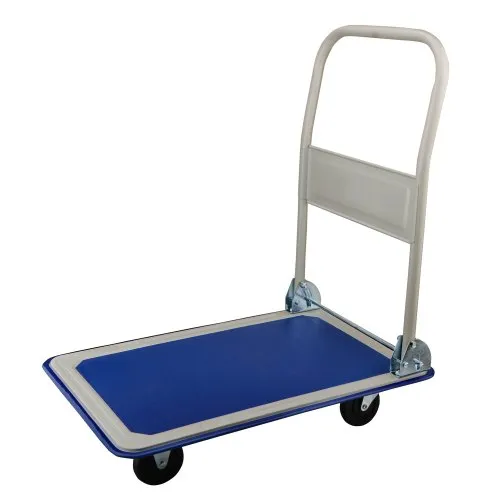

Platform trolley requirements run in line with prevailing macro-industry trends in manufacturing, e-commerce and urban infrastructure. Asia–Pacific now represents most of global net sales, driven by flourishing fulfilment hubs that include India, Vietnam and Indonesia. U.S. and Canada warehouses, at the same time, are shifting to higher-spec ergonomic models as they compete over working conditions amid labour shortages. In Europe, there’s more demand for low-noise, all recyclable constructions that respond to increasingly stringent regulations like the European Green Deal. Even parts of Latin America that for years have been seen as cost-sensitive now regard the trolley as a necessity, not a luxury The salt-laden air and humidity of the coast means trolley corrosion is never more than a short downpour away. For procurement departments, these divided regional priorities are making sourcing a nightmare: a deck spec tuned to monsoon-soaked Chennai could flunk quickened salt-spray tests demanded in Sao Paulo. The hardiest supply chains, then, are those that nurture multi-regional vendor networks that protect against currency gyrations and geopolitical convulsions and keep material certificates, weld passports, and third-party fatigue reports standardized across plants on three continents.
Leading the Way in Materials Science
Metallurgical engineering has recently made available alloy families previously the domain of aerospace for ordinary material-handling. With duplex stainless steel, a 316L like corrosion resistance profile can be combined with the tensile-strength advantages found in the carbon-enriched grades for thinner decks that’ll still turn away caustic wash-down solutions. Micro-alloyed high-strength low-alloy (HSLA) steels reduce weight as much as thirty per cent over a similar capacity standard plate and man handle push forces also significantly on high frequency picking applications. On the polymers front, basalt-fibre-reinforced polypropylene decks come out of injection presses with honeycomb coring that absorbs impact energy and damps breakable lab glassware in pharmaceutical logistics. Each new material iteration pushes the envelope of what a platform trolley can withstand, reducing lifetime emissions by extending service life and cutting the raw-material tonnage per payload kilogram.
Designing for Climate Conditions
The temperatures hurt some of the more apparently stoic steel and polymer frames. When exposed to sub-zero ambient air, typical polyurethane tyres become brittle and micro-crack, which ultimately leads to chunks of polyurethane blistering from the tyre face in the middle of a shift. In contrast, silicone elastomers remain elastic to –40 °C, albeit at three times the cost of raw compound. UV degradation and fungal attack are twin hazards posed by tropical climates. UV-stabilised polycarbonate corner protectors and mould-inhibiting deck coatings address these threats, however, it is the responsibility of purchasing to ensure that additive packages comply with local environmental bans on halogens and heavy metals. Heck, factories change too — a paper mill’s continual jungle of lignin dust infiltrates bearings unless you fit them with double-lip labyrinth seals to cover every gap, and a semiconductor clean room needs electro-polished stainless surfaces with no specks of foreign material anywhere capable of shedding particles. We identify these micro-climates so a trolley that we design for a fulfilment centre in the Midwest doesn’t inadvertently become a high-maintenance problem on the coast of Queensland.
Universal design and workforce diversity
Workforces are more diverse than ever — in height, broadness and neurology — yet many of these trolley fleets are still stubbornly one-size-fits-all. Progressive manufacturers like equip2go now provide handles that are telescopic in a 250-mm range to stroke from within the 5th to the 95th percentile of these Asian female workers without bringing the shoulder to the awkward position. Preset push handles, left- or right-bias, respect operators with reduced mobility or a dominant hand, and low-allergen thermoplastic over-moulds help to protect workers who are susceptible to dermatitis. Foot brakes are colour-coded to help the colour-blind staff as they combine colour with tactile ridges to ensure that nothing ever has to rely purely on sight to activate. Those inclusive touches go beyond compliance check-boxes, to stretching a hiring pool and reducing fatigue variance across shifts, to sending a cultural signal that ergonomic accommodation is respect for people’s unique needs.