
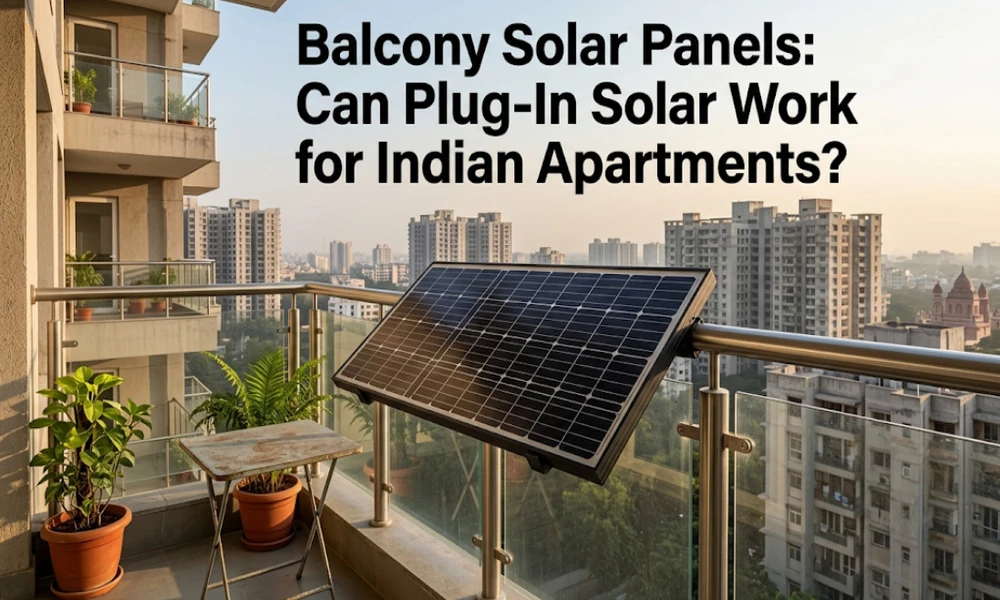

Not having to live in a house to utilize solar power might be true. Those residing in houses with rooftops have a greater choice of setting up solar panels, while those living in apartments might consider smaller-scale solar arrangements that can harness the power of their balconies.
And here come balcony solar panels, which help to produce electricity through solar energy without installing the whole array of solar panels on your roof. This sounds convenient enough; however, does it mean that all you need to do is plug your solar panel into the wall outlet and save money on your electricity bills in India?
What Are Balcony Solar Panels?
Balcony solar panels are portable solar panels mounted on balcony railings, wall mounts, or any other compatible supporting structure. They come in handy especially for residential apartments where there is no access to the roof area.
Some systems have a small solar panel mounted with a micro-inverter that converts the electricity produced to usable alternating current, while others might even have a battery for storing electricity for future use.
Plug-and-play solar panels, popular in many parts of Europe, are meant to plug into the residential electrical wiring network using a compatible plug-in system. Not all balcony solar kits, however, are meant to plug into the conventional outlet sockets available in India.
How Does a Plug-In Solar System Function?
It is relatively simple to understand. The solar panel collects sunlight and produces DC electricity. A micro-inverter changes this electricity into AC, which in turn supplies the home’s appliances via an appropriate electrical connection.
Where there is sunlight, the electricity produced can be used to power devices like routers, lights, and others. In case the electricity produced is less than what is required by the apartment, the balance is provided by the electricity source.
Nevertheless, the amount of electricity produced depends on many things, such as the size of the panel, amount of sunlight received, direction of the balcony, and shading from adjacent buildings. Balconies receiving sunlight for a few hours may not produce much electricity compared to rooftops.
What Are the Benefits of Balcony Solar Panels?
1. They make use of limited space
Not every apartment owner has access to a rooftop. Balcony installations offer another way to explore solar power without needing a separate plot of land.
2. They can help reduce electricity consumption
A suitably sized system can offset part of an apartment’s electricity use during sunny hours. The actual savings depend on how much power the panels generate and whether that electricity can be used directly by household appliances.
3. They are relatively compact
Smaller systems can be easier to accommodate than conventional rooftop installations. However, the mounting structure must be secure, particularly in high-rise buildings exposed to strong winds.
4. They introduce residents to solar energy
For people interested in renewable energy but unable to install a full rooftop system, balcony solar can be an opportunity to understand how solar electricity works and how it fits into everyday energy use.
What Challenges Should Indian Apartment Residents Consider?
Balcony solar is not always suitable for apartments. Insufficient sunlight is one of the most common issues; it becomes especially relevant when there are other high-rise buildings around. Additionally, dust, shadows, and orientation of the balcony could influence electricity production.
It is crucial to think about safety measures. The panels need to be attached properly and firmly so that the wind does not knock them off. The installation process should not block any emergency passages or damage the external surfaces of the building. There should be no risk for people passing under it.
The apartment owners also need to make sure whether it is allowed to install equipment on balconies and external walls according to the regulations of their housing societies. If the electricity from this system would be connected to apartment wiring or the public network, the regulations of electricity distribution companies in the area and the electrical safety authorities should be followed.
One more thing to consider is the cost: a small system produces electricity in small amounts.
Selecting Appropriate Solar Panels for Your Balcony
The first step would be to evaluate the amount of sunlight exposure that your balcony gets throughout the day. Then, it will be necessary to take into account the space available, the ways to mount solar panels, and the electrical load to be compensated.
The size of the panel, its capacity, warranty, and compatibility with installation should also be considered. It will be useful to compare solar panels from reliable manufacturers of photovoltaic modules to understand the differences in technology, quality, and long-term use.
Additionally, it is vital to choose appropriate inverters and mounts rather than choosing panels according to wattage only. In case you need to provide power for some of your devices in the event of blackouts, keep in mind that standard systems tend to stop functioning during power cuts.
Conclusion
Balcony solar panels offer an interesting option for apartment residents who want to explore solar energy without access to a rooftop. However, their usefulness depends on sunlight, available space, installation safety, and India’s applicable electrical requirements. As a leading PV solar module manufacturer in India with over 25.8 GW in manufacturing capacity, Waaree offers a broad portfolio of solar technologies for different energy needs. For apartment residents considering solar, understanding the available options and choosing suitable equipment is the first step towards making better use of the sunlight their homes receive.