
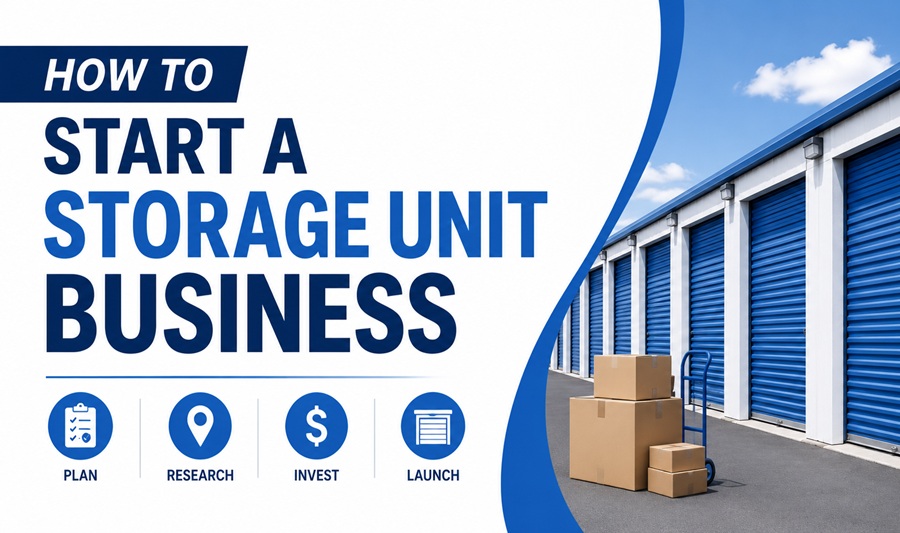

Self-storage has a reputation as one of the more reliable real estate asset classes in the United States. It outperformed most commercial real estate categories during the 2008 financial crisis, maintained occupancy through the COVID-19 pandemic, and has generated consistent investor returns across multiple economic cycles. That track record has attracted significant capital into the sector, which means the market a new operator enters today is more competitive and more institutionalized than it was a decade ago.
Starting a storage unit business in that environment requires clear-eyed analysis of the local market, realistic capital planning, and a business model that accounts for the competition from established operators rather than assuming the category’s historical performance will carry a new entrant automatically.
Understanding the Business Model
Self-storage is fundamentally a real estate business with operational characteristics that differ from most other commercial property types. The product is space rented on a month-to-month basis, typically without long-term leases. Customers are individuals and businesses storing household goods, business inventory, vehicles, and equipment. Revenue is predictable relative to many businesses but sensitive to local market conditions including supply levels, population density, and the residential and commercial activity that drives storage demand.
The economics of self-storage are driven by a combination of occupancy rate and rental rate per square foot. A facility that achieves 90 percent physical occupancy at competitive market rents generates strong returns. A facility that achieves the same occupancy at below-market rents, or market rents at 70 percent occupancy, generates significantly weaker returns on the same capital investment. Understanding the local market rental rates and realistic stabilized occupancy achievable in that market is foundational to the financial analysis of any self-storage project.
Operating expenses for self-storage are lower relative to revenue than most commercial real estate types. The business doesn’t require significant ongoing labor once established, has limited utility costs relative to other commercial property types, and benefits from the month-to-month lease structure that allows rapid rent adjustment in response to market conditions. These characteristics contribute to the relatively high net operating income margins that make self-storage attractive to investors.
Market Analysis: The Most Important Step Before Any Capital Commitment
The self-storage industry has attracted enough institutional capital that many markets in the United States are adequately or oversupplied. Entering an oversupplied market with a new facility creates a prolonged lease-up period with below-target occupancy and rental rates that can make the project economically marginal or worse.
Demand analysis for a self-storage project examines the population within the primary trade area, typically a three to five mile radius for urban markets and wider for rural ones, and estimates the demand for storage space based on population, household density, income levels, and residential characteristics. Renters generate more storage demand than homeowners because they have less storage space in their residences. Dense urban populations with smaller living spaces generate more demand per capita than suburban populations with larger homes and garages.
Supply analysis maps existing and under-construction self-storage facilities within the trade area, their total rentable square footage, their current occupancy rates where available, and their rental rates. Street rates published on competitor websites and facility aggregators including SpareFoot and StorageCafe provide rental rate data. Occupancy data requires either direct research through site visits and conversations with facility managers or access to paid market research from industry data providers.
The square footage per capita ratio is the primary metric used to assess market saturation in self-storage. National averages run approximately 5.5 to 6 square feet of storage per person. Markets significantly above that ratio are generally considered oversupplied. Markets below it may have demand that isn’t being served. The ratio alone doesn’t tell the complete story because facility quality, location accessibility, and demographic characteristics affect demand and achievable rents in ways the aggregate ratio doesn’t capture, but it provides a useful first screen.
Population growth, residential construction activity, and commercial development in the trade area provide forward-looking demand indicators. A market with strong population inflow, significant apartment construction, and active commercial development generates growing storage demand that supports new supply absorption more readily than a static or declining market.
Site Selection and Development Options
Self-storage projects can be developed in several configurations depending on the site, market, and capital available.
Ground-up development on a raw land parcel provides the most control over facility design, layout, and unit mix, and typically produces the lowest cost per square foot of rentable space for larger projects. The timeline from land acquisition through entitlement, construction, and lease-up typically runs two to four years, during which significant capital is deployed without revenue generation. Land cost, construction cost, and the entitlement process including zoning approvals and permits all need to be modeled accurately to produce a reliable feasibility analysis.
Conversion of existing buildings, particularly underutilized retail, industrial, and office buildings, has become an increasingly significant source of new self-storage supply as the repurposing of vacated retail space has accelerated. Conversion projects can reduce construction costs relative to ground-up development and often benefit from existing infrastructure including parking and utility connections. The feasibility of conversion depends on the building’s structural characteristics, ceiling heights, access configurations, and the extent of renovation required to create functional storage units.
Acquisition of existing facilities avoids the development risk and lease-up period of new construction at the cost of paying a premium for stabilized cash flow. Buying an existing facility with established occupancy and operations provides immediate revenue and eliminates the uncertainty of lease-up, but acquisition prices for well-located, stabilized facilities reflect the income they generate and require lower going-in yields than development projects targeting higher returns.
Outdoor storage on paved or gravel lots for vehicles, boats, and RVs represents a simpler entry point with lower construction costs than enclosed unit facilities. The revenue per square foot is lower than climate-controlled indoor storage, but the development cost is proportionally lower and the operational complexity is reduced. Outdoor storage works best in markets with strong demand for vehicle and recreational equipment storage, typically suburban and exurban markets where residents have boats, RVs, and other vehicles that don’t fit in residential garages.
Capital Requirements and Financing
Self-storage development and acquisition require significant capital, and understanding the full capital stack before committing to a project prevents the common problem of projects that run out of capital before reaching stabilized operations.
Ground-up development costs for a self-storage facility vary widely by market, configuration, and construction type. Simple single-story drive-up facilities in lower-cost markets can be developed for $25 to $45 per square foot of rentable space. Multi-story climate-controlled facilities in higher-cost markets run $60 to $100 per square foot or more. A 50,000 square foot facility at $50 per square foot represents a $2.5 million construction cost before land, soft costs, and working capital during lease-up.
Total project costs including land, construction, soft costs such as architecture, engineering, and permitting, and working capital reserves through stabilization typically run 20 to 30 percent above construction cost alone. A project with $2.5 million in construction cost may require $3 to $3.5 million in total capital to reach stabilized operations.
Financing for self-storage development comes from several sources. SBA 504 and 7(a) loan programs provide financing for owner-operated small business real estate projects at terms more favorable than conventional commercial loans, with lower down payment requirements and longer amortization periods. Conventional commercial real estate loans from banks and credit unions provide construction and permanent financing for larger projects. Private equity and joint ventures with experienced self-storage operators provide capital for developers who bring market knowledge and development capability but need financial partners.
Operational working capital during the lease-up period is a frequently underestimated component of the total capital requirement. A facility takes time to reach stabilized occupancy, and the gap between operating expenses and revenue during that period must be funded. Under-capitalizing the lease-up phase creates financial stress that affects operations and can jeopardize the project.
Facility Design and Unit Mix
The unit mix, the combination of unit sizes offered in the facility, determines the facility’s appeal to the broadest range of customers in the local market and its revenue-generating potential at full occupancy.
Standard unit sizes range from small lockers and 5×5 units used for document storage and small household items through 5×10 and 10×10 units suitable for apartment contents, to 10×20 and 10×30 units that accommodate household contents for larger homes. Unit size demand varies by market and demographic, with urban markets showing stronger demand for smaller units and suburban markets generating more demand for larger units.
Climate-controlled units maintain temperature and humidity within defined ranges and command rental rate premiums of 25 to 50 percent over non-climate-controlled units in most markets. They’re required for certain storage categories including electronics, wooden furniture, artwork, and documents, and their availability increases the facility’s appeal to customers with higher-value goods. Climate control requires HVAC infrastructure that adds construction cost relative to non-climate-controlled facilities.
Drive-up units with direct vehicle access at the unit door are preferred by customers storing heavy items, business inventory, and anything requiring frequent access. Interior units accessed through corridors and elevators are more efficient from a land use perspective and lower the construction cost per square foot, but sacrifice the convenience that some customers prioritize. A mix of both accommodates the widest range of customer needs.
Boat, RV, and vehicle storage bays provide covered or uncovered parking for oversized vehicles and are a revenue-generating complement to traditional storage units where land availability permits. These bays generate strong demand in markets with high recreational vehicle ownership and command meaningful rental rates relative to the land area they occupy.
Security features including perimeter fencing, electronic gate access, surveillance cameras, and individual unit alarms are baseline expectations for customers evaluating storage facilities. The quality of security infrastructure affects both the customer’s perception of the facility and the operator’s ability to command competitive rental rates.
Technology and Operations
Self-storage has adopted technology extensively over the past decade, and modern facility operations rely on management software and automation that reduce labor requirements while improving the customer experience.
Self-storage management software including StorEdge, Storable, and Sitelink handles online reservations and rentals, automated billing and payment processing, unit inventory management, revenue management, and customer communication. These platforms allow facilities to operate with minimal staffing by automating the processes that previously required a full-time manager on-site during all operating hours.
Online rental capability has become a baseline customer expectation. Customers researching storage options expect to view unit availability, see current rental rates, and complete the rental process online without requiring a phone call or in-person visit. Facilities without online rental capability lose customers to competitors that offer it before the customer contacts the facility directly.
Dynamic pricing, adjusting rental rates in response to occupancy levels and demand signals, is standard practice at institutional self-storage operators and increasingly adopted by independent operators. Revenue management software that automates pricing adjustments based on occupancy thresholds extracts more revenue from high-demand periods and accelerates occupancy growth during lease-up.
Automated access control through keypads or mobile app-based access allows customers to access the facility and their units without staff interaction. Facilities that operate unmanned during certain hours or entirely reduce labor costs significantly while maintaining the access convenience customers expect.
Competition From REITS and Large Operators
The competitive landscape in self-storage has shifted significantly as REITs and large operators have expanded aggressively. Public Storage, Extra Space Storage, CubeSmart, Life Storage, and National Storage Affiliates collectively operate thousands of facilities nationally and have advantages in brand recognition, technology investment, marketing spending, and operational efficiency that independent operators need a clear strategy to compete against.
Location is the most durable competitive advantage available to an independent operator. A well-located facility in a market with constrained supply and strong demand performs well regardless of nearby institutional competition because proximity and convenience drive most storage decisions. A customer who passes a well-located independent facility on their commute is more likely to choose it over an institutionally managed facility several miles away regardless of brand recognition.
Service quality and customer relationships represent another area where independent operators can differentiate from institutional competitors. The impersonal, automated experience at large portfolio facilities isn’t universally preferred, and some customer segments respond well to the attentive, personalized service that an owner-operated facility can provide more naturally than a managed facility in a large portfolio.
Third-party management arrangements with regional and national management companies including Absolute Storage Management and Storage Asset Management allow independent owners to access professional operational expertise and technology infrastructure without selling the asset. Management companies typically charge 5 to 8 percent of gross revenue plus fees for specific services, which buys operational competence and industry relationships that independent operators building their first facility don’t have internally.
Regulatory and Zoning Considerations
Self-storage facilities face zoning restrictions in many municipalities that limit where they can be located and what design standards they must meet. Zoning approvals are among the most significant sources of project risk and timeline uncertainty in self-storage development, and researching zoning compatibility before land acquisition prevents the situation where a site has been purchased before the zoning obstacle is understood.
Many municipalities zone self-storage in industrial or commercial areas and restrict it from retail corridors and mixed-use zones where the land value and development potential is higher. Some municipalities impose design standards requiring architectural treatment, landscaping, and facade quality that increases construction cost but improves compatibility with surrounding development.
Conditional use permits and variance applications are sometimes required even for sites where self-storage is theoretically permitted, adding time and cost to the entitlement process. Understanding the local political and community reception to self-storage in the target location, through conversations with local planning staff and review of recent approvals in the area, provides a realistic picture of entitlement risk before capital is committed.
The Self Storage Association is the primary industry trade organization for the self-storage industry, providing market research, operational benchmarks, regulatory guidance, and networking resources that represent the most credible industry-specific knowledge base for operators and developers entering the sector.
The Financial Model
A credible financial model for a self-storage project incorporates realistic assumptions about lease-up timeline, stabilized occupancy, achievable rental rates, operating expenses, and capital costs that can be stress-tested against unfavorable scenarios.
Lease-up assumptions should reflect the local market’s absorption capacity rather than optimistic projections. Well-located facilities in supply-constrained markets with strong demand reach stabilized occupancy in 18 to 36 months. Facilities in competitive markets with existing oversupply take longer and may stabilize at lower occupancy and rental rates than underwritten.
Stabilized operating expenses for a self-storage facility typically run 35 to 45 percent of gross revenue, producing net operating income margins of 55 to 65 percent at stabilization. Operating expenses include property taxes, insurance, utilities, management fees or labor, marketing, maintenance, and technology costs.
Cap rate applied to stabilized net operating income produces an estimate of the facility’s value at stabilization and the potential exit value relative to total project cost. The development spread between the project cost and the stabilized value represents the return generated through the development process and the reward for the development risk undertaken.