
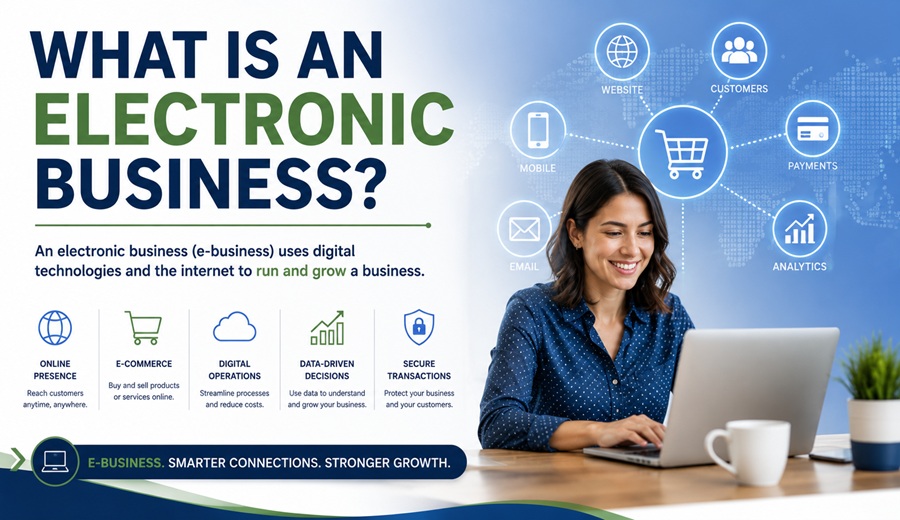

The term “electronic business” gets thrown around a lot — sometimes interchangeably with e-commerce, sometimes not. So let’s clear it up right away.
An electronic business (e-business) is any business that conducts its core operations through digital and internet-based platforms. This includes not just selling online, but also communication, supply chain management, customer service, and internal processes. E-commerce is just one part of e-business — the sales part.
E-Business vs. E-Commerce: The Key Difference
People use these terms as if they mean the same thing. They don’t.
| E-Commerce | E-Business | |
| What it covers | Online buying and selling | All digital business operations |
| Scope | Narrow (transactions) | Broad (entire business) |
| Example | Selling shoes on a website | Everything that makes selling shoes digitally possible — the website, logistics software, customer support portal, supplier portal, inventory system |
Think of it this way: every e-commerce business is an e-business, but not every e-business sells products online. A company that manages its supply chain, internal HR, and customer communication entirely digitally is an e-business — even if no transaction happens on their website.
Types of E-Business Models
| Model | Stands For | What It Means | Example |
| B2C | Business to Consumer | Sell directly to end customers online | Amazon, Netflix |
| B2B | Business to Business | Sell to other companies digitally | Salesforce, Shopify |
| C2C | Consumer to Consumer | Platform facilitating individual sales | eBay, Etsy, Facebook Marketplace |
| B2G | Business to Government | Selling services/products to gov entities | Defense contractors, cloud providers |
| D2C | Direct to Consumer | Brand sells directly, skipping retailers | Warby Parker, Casper |
What Makes Up an E-Business?
A fully functional e-business typically runs on several interconnected digital systems:
Online storefront or web presence — The customer-facing side. This could be a product website, a service booking portal, or a marketplace listing.
Digital payment processing — Stripe, PayPal, Square, or direct bank integrations that allow seamless transactions.
Customer Relationship Management (CRM) — Software like HubSpot or Salesforce that tracks customer interactions, leads, and communications.
Supply chain and inventory management — Digital systems that manage stock levels, supplier orders, and fulfillment logistics.
Digital marketing — Email, social media, SEO, and paid advertising that drive customers to the business.
All of these working together — not just the website — is what constitutes a true e-business.
Benefits of Running an Electronic Business
Lower overhead. No physical storefront means no rent, utilities, or the overhead costs tied to a brick-and-mortar location.
24/7 availability. Your business can take orders, answer questions (via chatbot or FAQ), and process payments around the clock without staff on duty.
Global reach. A physical business serves its local area. An electronic business can serve customers in any country that has internet access and where you can ship or deliver digitally.
Data-driven decisions. Every digital interaction generates data. E-businesses can track what customers buy, when they leave the checkout process, which marketing channels convert, and more — all in real time.
Challenges Worth Knowing
Cybersecurity risks. Any business handling customer data or payments online is a potential target. Security investment is non-optional.
Digital marketing competition. Getting found online is harder than it was a decade ago. Paid ads and SEO both require real investment.
Logistics and fulfillment. Selling physical products online means building a reliable way to store, pack, and ship them — or outsourcing it to a 3PL (third-party logistics provider).
Customer trust. Without a physical presence, building customer trust takes more deliberate effort through reviews, security badges, and clear return policies.
How to Start an Electronic Business
Starting an e-business is more accessible than ever. Here’s the basic framework:
- Choose a model — are you selling products, services, subscriptions, or information?
- Register your business and get an EIN.
- Build your digital home — Shopify, Squarespace, or WordPress for most businesses.
- Set up payments — Stripe or PayPal integrations are the fastest path.
- Connect your tools — accounting (QuickBooks), CRM (HubSpot), email marketing (Mailchimp).
- Drive traffic — start with SEO and one or two social channels before adding paid ads.
The definition of “electronic business” keeps expanding as more traditional business functions move online. Whether you’re a solo freelancer with a website or a company managing a global supply chain through digital systems, you’re operating in this space — and that’s increasingly just the normal way businesses work.